Article: The Bottom Line: Is Facial Oil Good for Oily Skin?

The Bottom Line: Is Facial Oil Good for Oily Skin?
If your skin already feels oily, applying more oil may sound like the last thing it needs.
It is one of skincare’s most persistent questions: Can facial oil actually be good for oily skin?
The answer is more nuanced than a simple yes or no.
Oily skin still needs moisture and a healthy skin barrier. But that does not mean every facial oil—or every oil-based formula—is appropriate for oily or acne-prone skin. The type of oil, the complete formulation, how much you apply, and how your individual skin responds all matter.
Understanding the difference can help you choose skincare based on what your skin actually needs rather than one of the many myths surrounding facial oils.
Why Does Skin Become Oily?
Our skin naturally produces sebum, an oily substance made by the sebaceous glands.
Sebum is not the enemy. It forms part of the skin’s natural protective system and helps keep the skin from becoming excessively dry.
Some people simply produce more sebum than others. Genetics, hormones, age, climate, stress, and skincare habits can all influence how oily the skin appears.
Oily skin is often characterized by noticeable shine, particularly through the forehead, nose, and chin. It may also be associated with enlarged-looking pores and a greater tendency toward clogged pores or breakouts.
But having oily skin does not mean your skin should be stripped of all oil.
In fact, aggressive cleansing, frequent scrubbing, and harsh astringents can irritate the skin rather than improve it.
Oily Skin Can Still Need Moisture
One of the biggest misconceptions about oily skin is that it does not need moisturizing.
Oil and hydration are not the same thing.
Sebum refers to the lipids produced by your skin, while hydration refers to its water content. This means skin can feel oily at the surface while still benefiting from products that help maintain moisture and support the skin barrier.
The goal should not necessarily be to eliminate oil.
It should be to maintain balance.
A gentle cleanser, appropriate moisturizer, daily sunscreen, and thoughtfully selected treatment products can often provide a better foundation than repeatedly trying to “dry out” oily skin.
So, Can You Use Facial Oil on Oily Skin?
Potentially—but choosing the right product matters.
Plant oils differ considerably in their fatty-acid composition, texture, stability, and behavior on the skin. A lightweight botanical oil and a heavy occlusive oil should not automatically be treated as interchangeable simply because both are called “facial oils.”
Research into topical plant oils also suggests that their fatty-acid profiles matter to skin-barrier function. In particular, linoleic acid plays an important role in the skin barrier, while oils dominated by different fatty-acid profiles can behave differently when applied to the skin.
This is why the question should not simply be:
“Is oil good or bad for oily skin?”
A better question is:
“Is this particular formulation appropriate for my skin?”
Will Facial Oil Clog Your Pores?
Not necessarily—but no facial oil can be assumed to be suitable for every acne-prone complexion.
“Comedogenic” describes a product or ingredient’s tendency to contribute to clogged pores.
You may have seen online charts assigning ingredients a comedogenic rating from zero to five. These lists can be tempting to use as definitive guides, but skincare formulation is more complicated than a single number.
Concentration matters. Ingredient combinations matter. The finished formulation matters. And individual skin response matters.
For people who are prone to acne or clogged pores, choosing products labeled non-comedogenic or won’t clog pores is a more practical starting point than assuming all botanical oils are automatically acne-friendly.
Facial Oil and Acne-Prone Skin Are Not the Same Conversation
It is also important to distinguish oily skin from acne-prone skin.
You can have oily skin without acne.
You can have acne while experiencing dryness and irritation.
And you can have combination skin that behaves differently across different areas of the face.
If you have persistent acne, facial oil should not be viewed as an acne treatment. Acne is a multifactorial skin condition, and evidence-based acne treatments may be necessary.
This distinction matters because skincare marketing sometimes implies that simply “balancing your oils” will resolve breakouts.
Skin biology is not that simple.
Why the Quality of Botanical Oils Matters
When choosing botanical skincare, the name of the plant on the ingredient list is only part of the story.
Quality can also depend on how an oil was sourced, extracted, processed, stored, and ultimately formulated.
Different botanical oils contain different combinations of fatty acids and naturally occurring compounds. Some are richer in linoleic acid, while others contain higher proportions of oleic acid or other lipids.
That composition influences how an oil feels and behaves on the skin.
It is one reason we believe botanical skincare should be formulated intentionally rather than simply combining as many fashionable plant oils as possible.
More ingredients do not necessarily make better skincare.
How to Introduce a Facial Oil If You Have Oily Skin
If you want to experiment with a facial oil or an oil-based serum, simplicity is your friend.
Start with a small amount rather than saturating the skin. Introduce one new product at a time so you can observe how your skin responds.
Pay attention over the following days and weeks.
Does your skin feel comfortable and supple?
Or are you noticing new congestion, persistent bumps, irritation, or increased breakouts?
Your skin’s response matters more than a trend or a generalized rule about what your skin type “should” use.
And if you are acne-prone, look for products specifically formulated with that concern in mind.
Where Does a Botanical Serum Fit?
A thoughtfully formulated botanical serum can offer something different from simply applying a single kitchen or carrier oil to the face.
At re: Skin Ethos, our approach is centered on purposeful formulation.
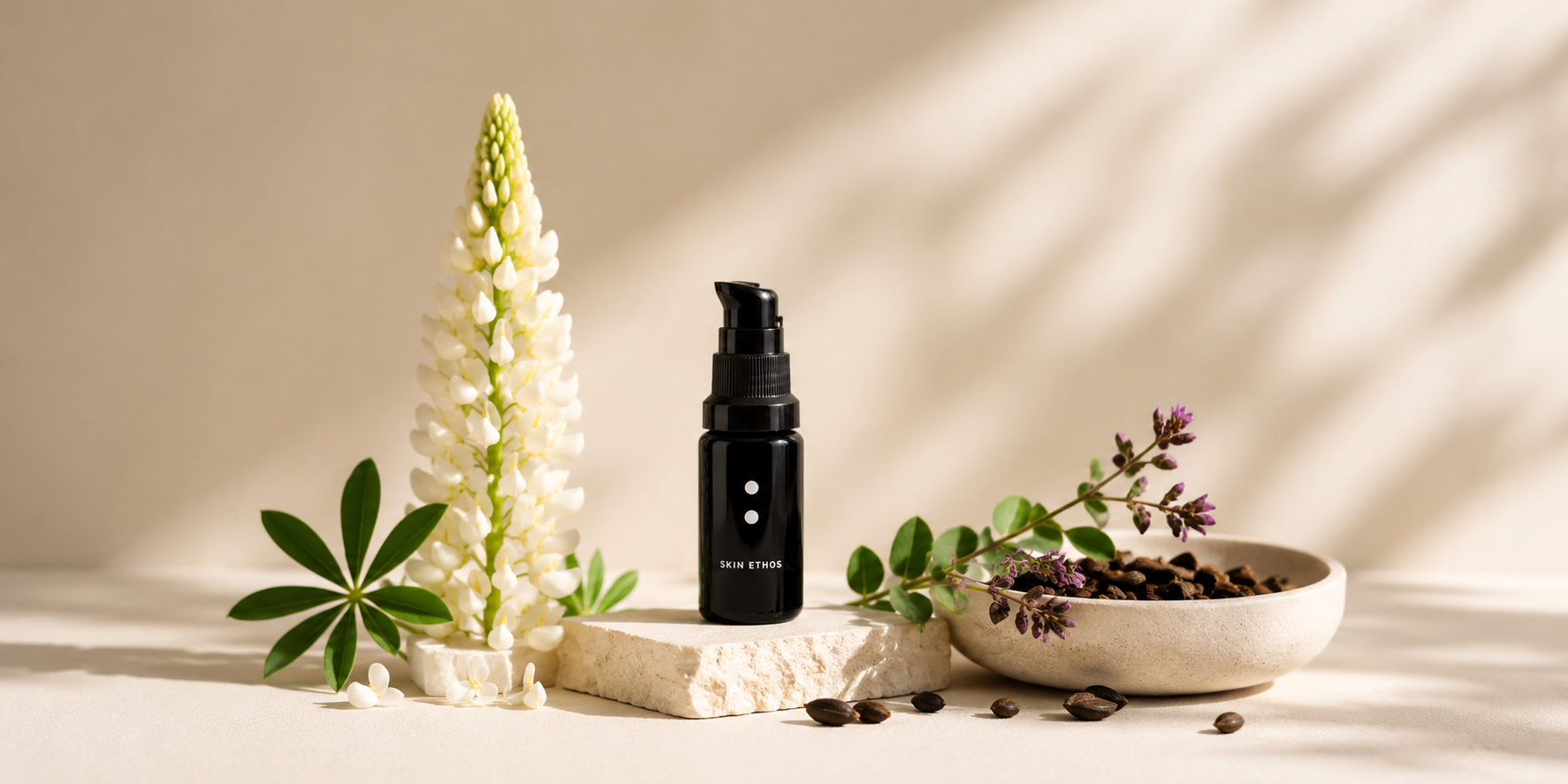
Our Bakuchiol Serum combines Bakuchiol with carefully selected botanical ingredients, including White Lupin Extract, Rosehip Seed Extract, Raspberry Seed Extract, and Pomegranate Seed Extract.
Rather than focusing on the idea that “more oil fixes oily skin,” we focus on creating a considered botanical formula designed to nourish and support healthy-looking skin.
That distinction matters.
Skincare should never rely on a catchy rule when the biology of skin is more complex.
A Simple Routine for Oily Skin
For many people, an effective routine does not need ten steps.
Start with a gentle cleanser that removes sunscreen, makeup, excess sebum, and daily impurities without leaving the skin feeling stripped.
Follow with the treatment or serum appropriate for your individual concerns.
Add moisturizer when needed, particularly if your skin feels dry or tight.
And during the day, finish with broad-spectrum SPF 30 or higher.
If you decide to incorporate an oil-based serum, a few drops may be all you need. More product does not necessarily mean better results.
The Bottom Line: Is Facial Oil Good for Oily Skin?
It can be—but facial oil is neither automatically good nor automatically bad for oily skin.
Oily skin needs to be treated with balance rather than aggression. It still requires hydration, barrier support, and gentle care.
At the same time, people who are prone to clogged pores or acne should be particularly thoughtful about the products they choose.
The quality of the ingredients matters.
The formulation matters.
And most importantly, how your own skin responds matters.
At re: Skin Ethos, we believe skincare should be intentional rather than excessive. Instead of fighting your skin, understand what it needs—and choose every product with purpose.
Discover a More Intentional Approach to Botanical Skincare
Explore the re: Skin Ethos Bakuchiol Serum, thoughtfully formulated with Bakuchiol and carefully selected botanical ingredients to support smooth, nourished, healthy-looking skin.