Article: Oil Cleansing vs. Traditional Cleansers: Which Is Better for Your Skin?
Oil Cleansing vs. Traditional Cleansers: Which Is Better for Your Skin?
Cleansing is one of the most familiar steps in skincare. It is where our daily routines begin, where makeup and the traces of the day are washed away, and where we prepare our skin for whatever comes next.
Yet with so many cleansing options available—from foaming gels and creamy formulas to cleansing balms and botanical oils—choosing the right one can feel surprisingly complicated.
Among these options, oil cleansing has attracted particular attention. Once considered unconventional, oil-based cleansers have become a familiar part of modern skincare routines, especially with the growing popularity of oil-to-milk formulations.
But what makes oil cleansing different from traditional cleansing? And is one necessarily better than the other?
The answer begins with understanding how cleansers are formulated and why the experience of cleansing can vary so significantly from one product to another.
Understanding the Purpose of Cleansing
Throughout the day, the skin comes into contact with a combination of substances, including natural sebum, perspiration, environmental particles, sunscreen, and makeup.
Cleansing helps remove these materials from the skin's surface.
While water alone can rinse away certain water-soluble substances, oils and other lipid-based materials do not readily mix with water. This is why skincare cleansers are formulated with ingredients that help lift, disperse, or dissolve different types of impurities.
The purpose of cleansing is straightforward, but the chemistry behind it can be surprisingly sophisticated.
Different formulations approach the same task in different ways, offering a range of textures, application methods, and sensory experiences.
What Is Traditional Facial Cleansing?
Traditional facial cleansers are generally water-based formulations available as gels, creams, lotions, and foams.
Most contain surfactants—ingredients that help oil and water interact.
Surfactants have a molecular structure that allows them to associate with both water and oily substances. This enables materials such as sebum and certain cosmetic residues to be dispersed and rinsed away.
Not all surfactants behave identically, and their characteristics depend on the specific ingredients and the complete formulation.
Some cleansers produce a rich foam, while others create very little lather.
Similarly, a cleanser's texture does not necessarily determine how gentle or effective it will be.
A foaming cleanser is not automatically harsh, just as a creamy cleanser is not automatically suitable for sensitive skin.
The overall formulation matters more than appearances.
What Is Oil Cleansing?
Oil cleansing takes a different approach.
Rather than beginning with a predominantly water-based texture, an oil cleanser uses an oil-rich formulation to interact with oily substances on the skin's surface.
This approach is often explained through the chemistry principle that substances with similar properties tend to dissolve one another.
However, cosmetic oil cleansing involves more than simply applying a plant oil to the face.
A formulated cleansing oil may contain a combination of oils, emollients, and emulsifying ingredients selected to create a particular texture and rinsing experience.
The presence and type of emulsifiers are especially important because they influence how the formula behaves when water is introduced.
This brings us to one of the most interesting developments in modern cleansing: the oil-to-milk cleanser.
What Makes an Oil-to-Milk Cleanser Different?
An oil-to-milk cleanser is designed around a transformation in texture.
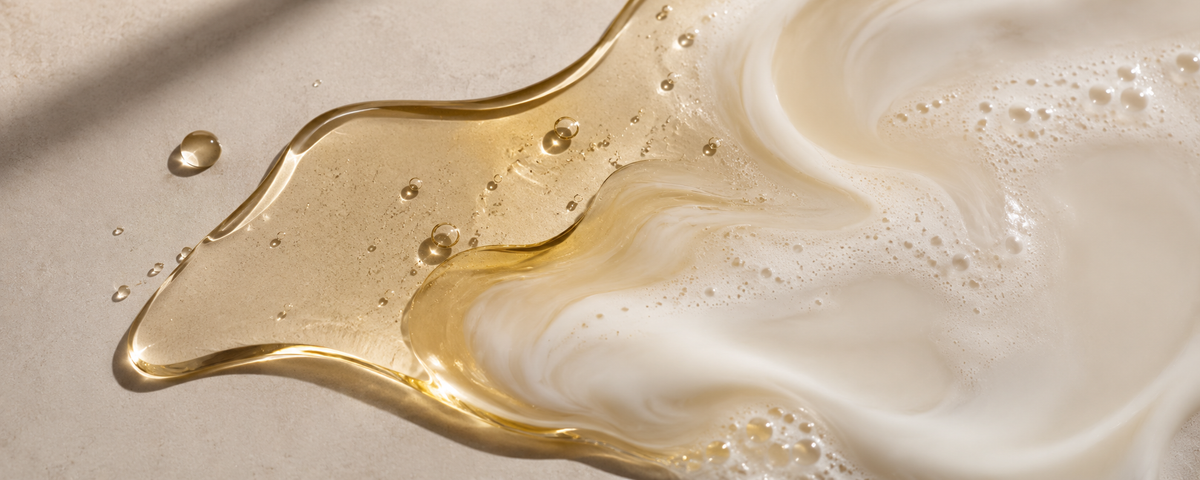
It begins with an oil-based consistency. When water is added, the formulation emulsifies, changing into a milky-looking dispersion.
This transformation occurs because emulsifying ingredients help oil and water mix into a temporary, finely dispersed system.
The result is a different cleansing experience from both a traditional foaming cleanser and a plain botanical oil.
The oil-to-milk concept is an example of how formulation science can influence not only the physical characteristics of a product but also the ritual of using it.
It offers an interesting intersection between cosmetic chemistry, texture, and sensory design.
Oil Cleansers vs. Water-Based Cleansers: Is One Better?
There is no universal answer.
Both oil-based and water-based cleansers can be thoughtfully formulated, and both have established roles in skincare.
Their differences are primarily related to formulation, texture, application, and how their ingredients interact with substances on the skin.
Water-based cleansers are available in a wide variety of textures, from lightweight gels to rich creams.
Oil cleansers offer a different tactile experience and may be formulated to emulsify when rinsed with water.
Neither category should be judged solely by its name.
The individual formula, its ingredients, and personal preferences are all relevant when choosing a cleanser.
For some people, a lightweight gel feels most comfortable. Others prefer a creamy texture or the experience of massaging an oil-based product into the skin.
Skincare does not need to follow a single formula for everyone.
Can Oily Skin Use an Oil Cleanser?
The idea of applying an oil-based product to oily skin may initially seem contradictory.
However, oily skin is not defined by an inability to tolerate all oil-containing skincare products.
Sebum production is influenced by several factors, including genetics, hormones, and age.
Meanwhile, cosmetic oils vary considerably in their chemical composition, texture, and behavior within finished formulations.
This means that an oil cleanser cannot be evaluated simply by the presence of oil.
It is also important to distinguish between oily skin and acne-prone skin. Although the two can overlap, they are not interchangeable.
Individuals who frequently experience clogged pores or breakouts may prefer to look for products specifically labeled non-comedogenic.
As with other skincare categories, individual tolerance and the complete formulation remain important considerations.
What About Sensitive Skin?
Sensitive skin is another area where generalizations can be misleading.
A product described as natural, botanical, or oil-based is not necessarily more suitable for sensitive skin than a conventional water-based formula.
Skin reactions can be influenced by many factors, including fragrance components, individual ingredients, formulation characteristics, and personal sensitivities.
Even ingredients derived from plants can cause irritation or allergic reactions in some individuals.
For this reason, understanding the full ingredient list is more useful than relying exclusively on broad marketing descriptions.
A gentle skincare routine is not defined by whether its ingredients come from nature or a laboratory.
It is defined by how well the selected products suit the individual.
Is Double Cleansing Necessary?
Double cleansing has become a familiar term in contemporary skincare.
The method generally involves two steps: an oil-based cleanser followed by a water-based cleanser.
It is often associated with routines that involve makeup, sunscreen, or multiple layers of cosmetic products.
However, double cleansing is not a universal requirement.
Whether one or two cleansing steps are appropriate depends on the products being removed, the cleansing formulations used, and individual skin needs.
Adding more steps does not automatically create a better routine.
For those who prefer simplicity, it may be worth considering whether their existing cleanser already meets their daily needs.
The most elaborate routine is not necessarily the most thoughtful one.
Why Formulation Matters More Than Trends
Skincare trends frequently place individual ingredients at the center of attention.
One season may celebrate a particular botanical oil. Another may focus on a new cleansing texture or an emerging active ingredient.
Yet the presence of a popular ingredient does not tell the whole story.
Formulation is the process of bringing ingredients together in a way that creates a finished product with specific physical and chemical characteristics.
This involves considerations such as compatibility, stability, texture, preservation where required, and packaging.
In oil-to-milk cleansing products, the relationship between oils and emulsifying ingredients is central to the formula's behavior.
This is why two products described as oil cleansers can feel and function differently.
The finished formulation deserves as much attention as the ingredients highlighted on the front label.
The Role of Botanical Ingredients in Modern Skincare
Botanical ingredients have long held a place in cosmetic formulation.
Plant-derived oils and extracts offer a diverse range of chemical compositions, textures, and sensory characteristics.
Their properties can vary depending on the botanical species, the part of the plant used, extraction methods, and processing conditions.
For example, a botanical oil obtained from seeds is not necessarily equivalent to an extract obtained from the same plant's leaves or flowers.
These distinctions matter when evaluating cosmetic ingredients.
Botanical skincare is not simply about including recognizable plant names in a formula.
It is about understanding the ingredients themselves and the role they play within the finished product.
The Lumière Cleansing Ritual
At re: Skin Ethos, we believe that even the most familiar skincare rituals deserve thoughtful attention.
Our Lumière Oil-to-Milk Cleanser reflects this philosophy through its distinctive formulation format and carefully selected botanical ingredients.
Featuring chamomile, sea buckthorn, and cloudberry extracts, Lumière brings together botanical inspiration and the sensory experience of an oil-to-milk texture.
Its transformation upon contact with water is a characteristic of the formulation itself—a small but distinctive detail within the everyday cleansing ritual.
For us, skincare is not about accumulating endless steps or following every emerging trend.
It is about appreciating the relationship between ingredients, formulation, and the experience of using a product.
Lumière is an expression of that approach.
Choosing a Cleanser That Fits Your Routine
When exploring different cleansing products, consider what matters most to you.
Perhaps you prefer the familiar texture of a gel cleanser, the richness of a cream, or the distinctive feel of an oil-based formula.
You may also wish to consider your skin type, personal sensitivities, makeup habits, and the number of steps you enjoy in your daily routine.
There is no single cleansing format that suits everyone.
Understanding how products differ makes it easier to approach skincare with curiosity rather than confusion.
And sometimes, simplifying your routine begins with understanding the products you already use.
A More Thoughtful Approach to Cleansing
The conversation around oil cleansing and traditional cleansing is not about declaring one method superior.
It is about recognizing that skincare formulations can approach the same purpose in different ways.
Water-based cleansers, cleansing oils, and oil-to-milk formulations each represent different applications of cosmetic chemistry.
What matters is choosing products that align with your individual preferences and skincare needs.
At re: Skin Ethos, we believe thoughtful skincare begins with understanding—not excess.
Because a considered routine is not necessarily the one with the most products, the most ingredients, or the most steps.
It is the one chosen with intention.
Discover Lumière
Explore the re: Skin Ethos Lumière Oil-to-Milk Cleanserwhere botanical inspiration meets thoughtful formulation and a distinctive cleansing ritual.